The right heat pump size is the capacity it delivers on your coldest design day, measured against what your house loses that day. The tonnage on the box doesn’t tell you that. In our example house, which loses 36,000 Btu/h at 9°F, a heat pump sold as 3 tons makes about 19,160 Btu/h at that temperature, extending the maker’s figures. That covers 53% of the load, leaves 16,840 Btu/h for backup heat, and sets the balance point near 25.5°F. The calculator on this page runs the same check on your load, your design temperature and the maker’s own capacity figures.
So “what size heat pump do I need?” has a two-part answer: a load in Btu/h, then a unit whose real output at your temperature fits it. This page is part of our heat pump sizing guides. It gives an estimate and it doesn’t replace a load calculation: ENERGY STAR tells homeowners to have the contractor verify size with Manual J. The Last Furnace sells and installs nothing.
What to enter
Four things drive the result. Three describe your house and its climate: the load, the design temperature and where heating stops. One describes the equipment: the maker’s capacity figures.
Your design heating load
This is the heat the house loses per hour at the design temperature. The calculator takes it three ways, from best to worst.
- A number from a load calculation. Manual J, sold by ACCA, is the usual method. NEEP’s guide says it must account for the building shell, air leakage and duct losses where ducts stay, and it recommends blower door testing because infiltration estimates are often overstated. Our load estimate from your fuel bills is a second opinion, not a Manual J.
- Your furnace’s output. Natural Resources Canada’s guide calls this a last resort. It works only if the home has had no comfort problems, no major energy upgrades since the furnace went in, and some evidence of sensible sizing, such as the furnace running for long stretches in very cold weather. The guide brackets heating output at 125% to 140% of the design load, figures tied to Canadian practice, not a US rule. A furnace with 72,000 Btu/h output gives about 51,400 to 57,600 Btu/h (our arithmetic). Use the output on the nameplate, not the input. A furnace that was oversized from the start will overstate your load.
- Floor area. This is the roughest route, and the 20 Btu/h per square foot default is our assumption with no primary source behind it. Try a low and a high figure and see how far the answer moves. The section on square-foot rules explains why.
Your design temperature
A design temperature is the cold-weather figure a load calculation is built on, not the record low. This table gives 99% heating values from two editions of ENERGY STAR’s county guide: the 2015 edition (revised November 2019) and the 2019 edition (revised April 2021), which the program has required for design reports since October 2020.
| County | 2015 edition | 2019 edition |
|---|---|---|
| Hennepin, Minnesota (Minneapolis) | -8°F | -11°F |
| Chittenden, Vermont (Burlington) | -4°F | -11°F |
| Albany, New York | 1°F | -3°F |
| Cook, Illinois (Chicago) | 2°F | -3°F |
| Denver, Colorado | 3°F | -2°F |
| Wayne, Michigan (Detroit) | 6°F | 4°F |
| Allegheny, Pennsylvania (Pittsburgh) | 9°F | 5°F |
| Suffolk, Massachusetts (Boston) | 12°F | 1°F |
| Davidson, Tennessee (Nashville) | 18°F | 14°F |
| Wake, North Carolina (Raleigh) | 23°F | 15°F |
| Fulton, Georgia (Atlanta) | 25°F | 20°F |
| King, Washington (Seattle) | 27°F | 11°F |
Treat both columns as starting points. They’re limit tables for ENERGY STAR new homes, not lists of ideal values. Where a county has several weather stations, the 2015 edition takes the lowest heating value, and a county with no station gets the closest one. The 2019 edition takes the lowest value from stations in the county or within 40 miles of its center, so a colder place can set the number: King County’s 11°F comes from Stampede Pass, and Suffolk County’s 1°F from Lowell. EPA recommends the Manual J value for the location nearest the home, so your installer’s figure beats either column. Use the temperature your load number was calculated at. Programs may use a different percentile: Efficiency Maine’s claim form lists 99.6% values, such as 1°F for Portland, so don’t mix numbers from two tables without naming each.
The maker’s capacity figures
Take these from the extended performance table for your exact outdoor and indoor pair. Enter maximum capacity at each temperature, as the Canadian guide advises. Many sheets give 47°F and 17°F. Enter the coldest row as well if there is one. Carrier’s heating table stops at -3°F, for example, and the ENERGY STAR cold climate test point is 5°F.
If your design temperature falls below the coldest row, the tool extends the line and shows how many degrees past the data it went. Treat that result as a guess. Carrier’s sheet says outright that extrapolation “is not an acceptable practice” for its data.
Where heating stops
The load line needs a second point: the outdoor temperature where the house needs no heat. DOE’s Building America guideline and NREL’s field study both use 65°F. Natural Resources Canada uses 60°F, based on field observations of solar and internal gains. It’s an assumption either way, and we default to 65°F, which gives a slightly higher load on mild days.
Worked example and the formula
The defaults describe an example house near Pittsburgh: 36,000 Btu/h at 9°F, the 2015-edition figure, with a Rheem WP14AY36 and WH2TY3617 air handler, a two-stage 3-ton pair the maker rates at 14.3 SEER2 and 7.5 HSPF2. The maker’s sheet gives 33,600 Btu/h at 47°F and 22,200 Btu/h at 17°F, with no colder figure. The sheet calls this data reference-only and points to AHRI for official ratings. It’s an example of an ordinary unit, not a recommendation.
- Load in tons. 36,000 ÷ 12,000 = 3.00 tons, at the standard 12,000 Btu/h per ton.
- House heat loss per degree. Design load ÷ (zero-load temperature − design temperature): 36,000 ÷ (65 − 9) = 642.9 Btu/h per °F.
- House load at any temperature. 642.9 × (65 − temperature). That’s 30,857 Btu/h at 17°F and 11,571 Btu/h at 47°F.
- Capacity line. (33,600 − 22,200) ÷ 30 = 380 Btu/h lost for each degree the outdoor temperature falls. If you enter a colder row, the tool draws a second line from 17°F down to that row.
- Capacity at design temperature. 22,200 − (8 × 380) = 19,160 Btu/h. That’s 8 degrees below the sheet’s data, so it’s an estimate.
- Share of load. 19,160 ÷ 36,000 = 53%.
- Balance point. Where the two lines cross: (642.9 × 65 − 22,200 + 17 × 380) ÷ (642.9 + 380) = about 25.5°F.
- Backup heat. 36,000 − 19,160 = 16,840 Btu/h, or 4.9 kW at 3,412 Btu per kWh. If the heat pump failed outright, covering the whole load would take 10.6 kW.
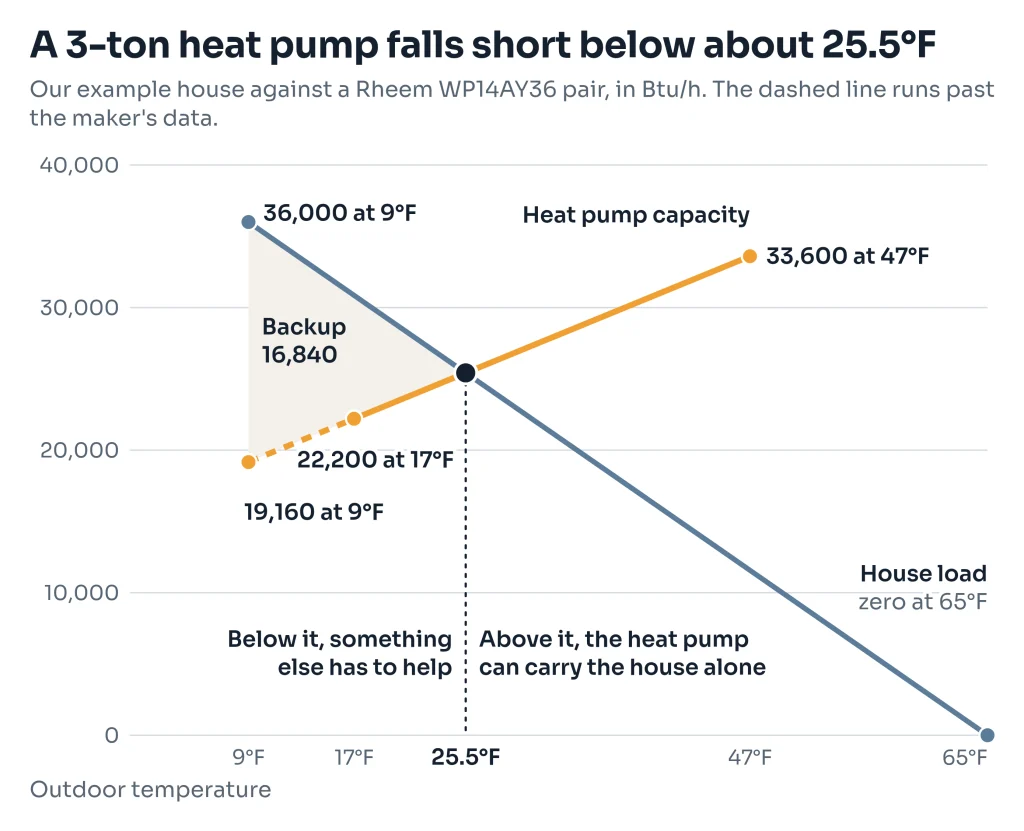
The two kW figures match the two kinds of backup in the Building America guideline: supplemental heat fills the gap at the design temperature, and emergency heat carries the full load if the heat pump is down. The kW results describe heat output, not a circuit. A licensed electrician works from the maker’s listed electrical data and your local code.
What the balance point tells you
Above the balance point, the heat pump can carry the house alone. Below it, something else has to help. NREL’s 2023 field study of centrally ducted heat pumps in Washington, Montana and Colorado shows how that plays out in real homes. It compared each unit’s maker-reported maximum capacity at the 99% design temperature with the home’s estimated design load.
| Site | Capacity as share of design load | Balance point | Design temperature |
|---|---|---|---|
| Site 1 | 118% | 13.8°F | 18.3°F |
| Site 9 | 98% | 12.3°F | 11.7°F |
| Site 12 | 84% | 15.3°F | 11°F |
| Site 11 | 63% | 23.8°F | 11°F |
| Site 5 | 39% | 36.9°F | 13.8°F |
| Site 8 | 37% | 38.8°F | 11°F |
These are six of the 12 sites in the report’s Table 6, and its loads assume 65°F indoors. The two sites with spare capacity, Sites 1 and 7, met more than 95% of the season’s heating with the compressor. Site 11, sized at 63% in a colder-than-normal winter, met less than 80% that way. Site 8 was undersized by an inefficient duct system, and electric backup met about 20% of its load. Weather, thermostat habits and controls matter too: Site 10 was sized at 50% and still met nearly 95% with the compressor, in a warmer-than-normal winter.
There’s no single right balance point. BPA’s sizing brochure for its Northwest program says that to minimize strip heat, size the compressor to supply all the heat above 30°F. Where a gas furnace is the backup, the same brochure says the choice is economic and usually lands around 40°F. Your program, climate and fuel prices decide which number matters.
Three sizing goals, three different targets
The target depends on what the heat pump is for. Natural Resources Canada’s guide splits this into options 4A to 4D, and NEEP’s cold-climate guide, written for variable-speed units and hosted by DOE, adds percentages for full replacement. Both are guidance, not US rules. Neither is Manual S, ACCA’s paid selection standard, which we haven’t read.
| Goal | Target | 36,000 Btu/h example |
|---|---|---|
| Sized for cooling, or a balance of cooling and heating | Match the cooling load (Canadian options 4A, 4B) | Needs a cooling load, which this tool doesn’t estimate |
| Heat pump does most heating, backup in deep cold | Capacity close to or above the load at 17°F (option 4C) | About 30,857 Btu/h at 17°F (30,353 on Canada’s 60°F line) |
| Heat pump replaces the system, little or no backup (NEEP) | 100% to 115% of the load at design temperature, no auxiliary heat | 36,000 to 41,400 Btu/h at 9°F |
| Same, with a small supplemental source (NEEP) | 75% to 85% of the load, plus just enough supplemental heat | 27,000 to 30,600 Btu/h at 9°F |
Rebate programs can set their own floor. Efficiency Maine’s claim form, for one, requires heat pumps sized for at least 80% of peak load, and 100% once supplemental heat is added, with a sizing worksheet attached. A furnace or boiler can stay for emergency backup there, but its capacity doesn’t count toward the 100%. Check your own program’s form before you sign, because the program decides what qualifies.
If you’re keeping the furnace
You may not need a full-load heat pump at all. NEEP says that when existing heat stays as backup, undersizing somewhat for heating should improve efficiency and reduce overall heating costs, and capacity at the design temperature becomes a secondary concern. A furnace can also be the cheaper winter fuel, which is what our dual fuel calculator and heat pump vs furnace guide work through. NEEP adds one warning: a heat pump that satisfies a whole-house thermostat in very cold weather can leave basements and remote areas colder than before, and pipes may freeze there. Ask your installer about it.
Heat pump size chart: what the label delivers
A nominal ton tells you little about winter output. Here’s what one ordinary line and one cold-climate unit list in heating, from the makers’ own sheets. The tons column is our arithmetic. The Rheem figures are its AHRI heating points for each listed pair, and the Carrier figures are maximum demand in Comfort Mode at 70°F indoors, net of defrost. Check the indoor match on any sheet you use.
| Maker’s size | Capacity at 47°F | Capacity at 17°F | 17°F as share of 47°F | Tons at 17°F |
|---|---|---|---|---|
| Rheem WP14AY, 2-ton | 22,800 Btu/h | 14,000 Btu/h | 61% | 1.2 |
| Rheem WP14AY, 3-ton | 33,600 Btu/h | 22,200 Btu/h | 66% | 1.9 |
| Rheem WP14AY, 3.5-ton | 39,500 Btu/h | 24,800 Btu/h | 63% | 2.1 |
| Rheem WP14AY, 4-ton | 44,000 Btu/h | 27,500 Btu/h | 63% | 2.3 |
| Rheem WP14AY, 5-ton | 54,000 Btu/h | 32,000 Btu/h | 59% | 2.7 |
| Carrier 27VNA1, size 54 (4.5 nominal tons) | 64,000 Btu/h | 50,500 Btu/h | 79% | 4.2 |
Running our example house through the calculator with four of these gives very different answers. Carrier’s row is figured with its -3°F point of 45,000 Btu/h. The sheet’s own 7°F figure is 51,000 Btu/h, so the straight line runs a little low here. Its -4.4°F balance point is just past that last row, so read it as colder than -3°F. The Rheem rows are extended below 17°F, past the maker’s data.
| Unit | Capacity at 9°F | Share of 36,000 Btu/h | Balance point | Backup at 9°F |
|---|---|---|---|---|
| Rheem 3-ton | 19,160 Btu/h | 53% | 25.5°F | 16,840 Btu/h (4.9 kW) |
| Rheem 4-ton | 23,100 Btu/h | 64% | 19.8°F | 12,900 Btu/h (3.8 kW) |
| Rheem 5-ton | 26,133 Btu/h | 73% | 16.2°F | 9,867 Btu/h (2.9 kW) |
| Carrier size 54 | 48,300 Btu/h | 134% | -4.4°F | 0 Btu/h |
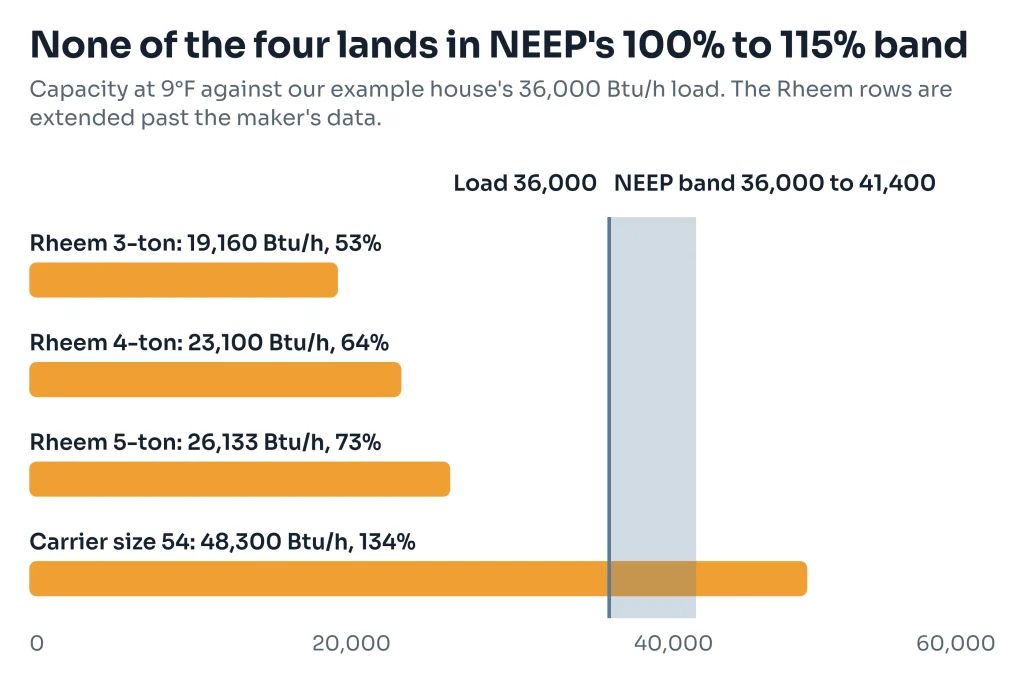
None of the four lands in NEEP’s 100% to 115% band for this house. The ordinary line never reaches the load, even at 5 tons. The Carrier passes it by a wide margin. A smaller cold-climate model or a planned backup may fit better than either end of this table. So may a smaller load: NEEP says to fix insulation and air leaks before buying where you can, because that reduces the size of equipment required.
What size heat pump for 2,000 sq ft?
Square footage can’t answer this, and the published rules show why. Here’s what three of them say for the same 2,000 sq ft.
| Rule | Who publishes it | Result for 2,000 sq ft |
|---|---|---|
| 1 ton per 600 sq ft | EnergySage, published estimate (updated 19 March 2026) | 3.3 tons |
| Square feet ÷ 500 | Rewiring America, describing a contractor rule | 4 tons |
| 30 Btu per sq ft | Rewiring America, describing a common rule | 5 tons (60,000 Btu/h) |
That’s 1.7 tons apart on the same house, from rules that take only floor area. EnergySage’s estimate adds that climate, insulation and ceiling height also matter, and its own sizing guide says shortcuts like these are “more often wrong than right.” Rewiring America compared two rules against Manual J loads in Massachusetts Clean Energy Center data. Even the better rule left 30% of loads oversized by more than a ton and 32% of homeowners with a seriously undersized unit. The article gives no sample size and no date, and it names that rule’s divisor inconsistently, so read that as a warning, not a statistic.
If floor area is all you have, use it to see the range, then get a load number before comparing models. Mini splits are sized by room or zone, so use our mini split size calculator for those.
Why bigger isn’t the easy fix
Going up a size to shrink the backup has real limits. NEEP warns that gross oversizing can cause excessive cycling, low efficiency and poor summer dehumidification, and that load calculations already have safety factors built in, so they shouldn’t be padded. Three checks help.
- Mild-day load. The calculator shows your load at 47°F. Compare it with the unit’s minimum capacity on the same sheet. NREL uses the point where minimum capacity meets the load line to estimate when a unit starts cycling. In our example the load at 47°F is 11,571 Btu/h. Carrier lists a 47°F minimum of 13,800 Btu/h in Efficiency Mode and 18,800 Btu/h in Comfort Mode, and 12,000 and 15,800 Btu/h at 37°F. On a straight line between those rows, that large unit would start cycling near 44°F or 39°F (our arithmetic). NREL expects real cycling at cooler temperatures, because load lines leave out solar and internal gains.
- Cooling. A heat pump is also your air conditioner. NEEP says to compare minimum-speed cooling capacity with the design cooling load and, if it is over 115% of that load, look for a higher heating-to-cooling ratio or a lower minimum capacity. The Rheem 5-ton in our table is rated at 54,000 Btu/h of cooling, so ask what that does to humidity in your house.
- Your existing furnace. For whole-house replacement, NEEP says heat pump capacity at design conditions “shall not exceed” existing heating capacity, and will often be smaller.
Variable speed softens this but doesn’t remove it: NEEP says it mitigates cooling oversize, and the checks above still apply. For how capacity and comfort hold up in deep cold, see our guide to cold-weather heat pumps.
Your ducts can cap the size
Existing ducts can limit what fits. Natural Resources Canada warns that full-load sizing may not be possible on ducts designed for a traditional furnace, unless the house’s shell has been improved. Its quick screen measures the supply trunks near the equipment:
- Rectangular trunks: depth × width in inches × 6.25 = maximum CFM.
- Round trunks: diameter in inches, squared, × 4.91 = maximum CFM.
The guide’s example has one 8 by 22 inch trunk and two 6-inch round trunks, for about 1,453 CFM. Those multipliers assume 900 feet per minute, a Canadian trade figure. At the conventional 400 CFM per 12,000 Btu/h in the Building America guideline, that’s about 3.6 tons of airflow (our arithmetic). Use it only as a first screen. ENERGY STAR’s bid checklist tells you to ask each contractor to test for the maximum system size your ductwork can take.
What to get in writing
Most of these questions come from ENERGY STAR’s bid comparison checklist and the guides above. A good quote can answer each one on paper.
- The load calculation itself, heating and cooling, with the design temperature, indoor temperature, air leakage figure and duct assumptions it used.
- Capacity at your design temperature for the exact outdoor and indoor pair, from the maker’s table, plus the AHRI certificate showing the pair is matched.
- The balance point and backup plan: what provides heat below it, how much, and what setting keeps backup off until it’s called for.
- Minimum capacity at 47°F compared with your mild-day load, and cooling capacity compared with your cooling load.
- The duct result: whether the ducts were tested, and the largest system they can take.
- The rebate form, if you’re counting on one, with its sizing rule filled in for this job.
If an installer sizes from square footage alone, or matches the old unit’s tonnage without a load number, ask them to run the calculation. If the numbers on the quote differ from yours, ask why: a good load calculation knows things this tool can’t.
What this calculator can’t do
- It doesn’t calculate your load. It takes a load and checks equipment against it, so a wrong load gives a wrong answer.
- It draws straight lines. Real capacity curves bend, as Carrier’s table shows between 7°F and 17°F.
- It doesn’t handle defrost unless your sheet does. NREL notes that maker data at 5°F, 17°F and 47°F tends to neglect capacity lost to defrost. Carrier’s table subtracts it. Others may not, so check the footnotes.
- It ignores room-by-room balance, ductwork losses you didn’t include, setback recovery and wind.
- It doesn’t cover cooling load, electrical capacity or running cost. Those need their own checks.
This page is general information, not professional, tax or legal advice. A qualified installer, your rebate program and your local building department decide what applies to your home.
Sources checked on 4 November 2026.
Formulas and sources
- Design heating load used: Natural Resources Canada: Air-Source Heat Pump Sizing and Selection Guide, v1.0 (Dec 2020)
- Design load in tons: EIA: Geothermal Heat Pump Manufacturing Activities 2009 (one ton of capacity is 12,000 Btu per hour)
- House heat loss per degree: DOE Building America: Strategy Guideline, HVAC Equipment Sizing (Feb 2012), balance-point diagram
- Capacity change per degree, 17°F to 47°F: Natural Resources Canada: Air-Source Heat Pump Sizing and Selection Guide, v1.0 (Dec 2020)
- Capacity change per degree below 17°F: Natural Resources Canada: Air-Source Heat Pump Sizing and Selection Guide, v1.0 (Dec 2020)
- Capacity at design temperature: Natural Resources Canada: Air-Source Heat Pump Sizing and Selection Guide, v1.0 (Dec 2020)
- Capacity as a share of the design load: NREL/TP-5500-84745: Field Validation of Air-Source Heat Pumps for Cold Climates (May 2023)
- House load at 17°F: Natural Resources Canada: Air-Source Heat Pump Sizing and Selection Guide, v1.0 (Dec 2020)
- House load at 47°F: NREL/TP-5500-84745: Field Validation of Air-Source Heat Pumps for Cold Climates (May 2023)
- Balance point estimate: Natural Resources Canada: Air-Source Heat Pump Sizing and Selection Guide, v1.0 (Dec 2020)
- Backup heat at design temperature: DOE Building America: Strategy Guideline, HVAC Equipment Sizing (Feb 2012), balance-point diagram
- Backup heat in kilowatts: DOE Building America: Strategy Guideline, HVAC Equipment Sizing (Feb 2012), balance-point diagram
- Heat to cover the whole load if the heat pump fails: DOE Building America: Strategy Guideline, HVAC Equipment Sizing (Feb 2012), balance-point diagram
- Degrees below the coldest maker's figure: Natural Resources Canada: Air-Source Heat Pump Sizing and Selection Guide, v1.0 (Dec 2020)
- Btu in one kilowatt-hour (3412, as of 2026-11-04): EIA: British thermal units, sample conversion factors (1 kWh = 3,412 Btu)
- Btu per hour in one ton of capacity (12000, as of 2009-12-31): EIA: Geothermal Heat Pump Manufacturing Activities 2009 (one ton of capacity is 12,000 Btu per hour)
Sources
- Natural Resources Canada: Air-Source Heat Pump Sizing and Selection Guide, v1.0 (21 December 2020)
- NEEP: Guide to Sizing and Selecting Air-Source Heat Pumps in Cold Climates (rev. 8 April 2020), hosted by DOE's Building Science Education Solution Center
- DOE Building America: Strategy Guideline, HVAC Equipment Sizing (February 2012)
- NREL/TP-5500-84745: Field Validation of Air-Source Heat Pumps for Cold Climates (May 2023)
- ENERGY STAR: Design Temperature Limit Reference Guide (2015 edition, revised November 2019)
- ENERGY STAR: Design Temperature Limit Reference Guide (2019 edition, revised 27 April 2021)
- ENERGY STAR: Air-Source Heat Pumps
- ENERGY STAR: Heating and Air Conditioning Installation Bid Comparison Checklist
- ENERGY STAR Version 6.2 Heat Pump Specification (Rev. March 2025)
- Rheem: WP14AY Endeavor Line Select Series heat pump product sheet (maker's data)
- Carrier: 27VNA1 Infinity Variable Speed Cold Climate Heat Pump, product data 27VNA1-02PD (maker's data)
- Efficiency Maine: Residential Heat Pump Claim Form and sizing worksheet (10/2/2026)
- Bonneville Power Administration: PTCS Heat Pump Sizing Reference Guide (undated brochure)
- ACCA: Manual J Residential Load Calculation, 8th edition (title only; paid standard, text not read)
- EIA: British thermal units (1 kWh = 3,412 Btu)
- EIA: Geothermal Heat Pump Manufacturing Activities 2009 (one ton = 12,000 Btu per hour)
- EnergySage: Costs and benefits of air-source heat pumps (updated 19 March 2026, published estimate of 1 ton per 600 sq ft)
- EnergySage: Heat pump sizing guide (updated 1 July 2026)
- Rewiring America: Heat pump sizing guide (undated)