A heat pump blowing cold air in heat mode is often doing its job. Cool air for a few minutes on a damp, cold day that then turns warm again is probably a defrost cycle. Air that feels lukewarm all the time while the house holds its temperature is probably normal too: an older Rheem owner’s manual says a heat pump’s air is only 15° to 30° warmer than the air in your home and will feel cool if it blows directly on you, and Carrier puts typical heat pump air at about 85°F to 100°F. The sign of a real fault is air at room temperature or colder that lasts well past a defrost while the house loses temperature.
Below: a 10-minute thermometer test, the checks makers’ manuals allow, and where to stop and call a technician. For other symptoms, start at the heat pump symptom chart. If there’s no air or no heat at all, go to heat pump not heating instead.
Match what you’re seeing
When the cold air happens tells you more than how cold it feels. Find your row, then read the section it points to.
| What you notice | Likely cause | What to do |
|---|---|---|
| Cool for a few minutes, then warm again. Steam outside, outdoor fan stopped | Defrost cycle | Wait it out. Nothing to fix |
| Lukewarm all the time, and the house stays at the set temperature | Normal heat pump air | Run the thermometer test if you want proof |
| Cool air between heating cycles, and the indoor fan never stops | Fan set to On | Set the fan to Auto |
| Cold air in Heat, and it started right after a new thermostat went in | Reversing-valve setting on the thermostat | Check the setting, or call the installer back |
| Air at room temperature, outdoor unit silent for more than a defrost | Outdoor unit off: power, a lockout or a fault | Check breakers once, then call |
| Outdoor unit runs, vents stay cold, house keeps cooling down | Reversing valve, refrigerant leak or another fault | Call a technician |
| Thick ice on the outdoor unit that doesn’t clear | Defrost isn’t working or water is refreezing | Call a technician. Don’t chip it |
| Mini split: very little air at first, or it pauses in frosty weather | The maker’s cold-air prevention or defrost | Wait. Check the manual for the indicator light |
The 10-minute thermometer test
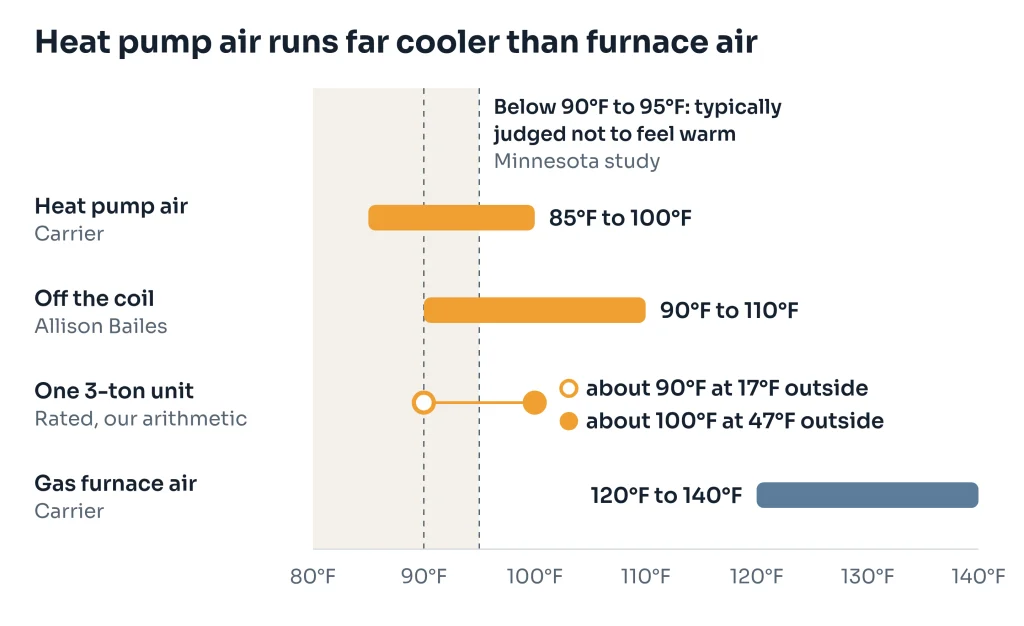
Your hand can’t settle this, because a working heat pump can still feel cool. A small study for Minnesota’s energy office said air below 90°F to 95°F is typically judged not to feel warm, and 3 of the 10 owners of hybrid systems it interviewed in depth reported issues with cool-feeling air from their registers (June 2011). A thermometer answers the question that matters: is the air coming out warmer than the air going in?
- Set the thermostat to Heat, with the set point about one degree above room temperature, which makes backup heat less likely to come on. Rheem warns that turning the setting up 2° or more brings on the auxiliary heat.
- Let the system run for at least 10 minutes (our assumption, not a maker’s figure). If you see steam outside or the outdoor fan has stopped, wait until it restarts and give it another 10.
- Hold a kitchen probe thermometer at the return grille, where air goes in, and note the reading.
- Hold it in the airflow at the supply register nearest the indoor unit, and note that reading.
- Subtract the first number from the second. That’s the rise.
A rise of 15°F to 30°F matches Rheem’s figure. With no auxiliary heat light on, it points to a heat pump that’s moving heat, however it feels. Backup strips alone can produce a rise too, so the light matters. Carrier gives about 85°F to 100°F for heat pump air against roughly 120°F to 140°F from a gas furnace (September 2026). Building scientist Allison Bailes says that, assuming proper installation, air off the coil is usually 90°F to 110°F, and he measured 105°F from his own system with 32°F outside (February 2024).
A somewhat smaller rise on a very cold day isn’t proof of a fault, because a heat pump delivers less heat as it gets colder outside. Take one ordinary ducted unit. Rheem’s February 2025 sheet rates the 3-ton WP14AY36AJ2N with its matched air handler at 33,600 Btu/h at 47°F outside and 22,200 Btu/h at 17°F, and lists 1,050 CFM of indoor air. Using the standard air-heat formula (rise = Btu/h ÷ (1.08 × CFM)) and assuming the same airflow in heating:
| Outdoor temperature | Rated capacity | Rise (our arithmetic) | Vent air with 70°F going in |
|---|---|---|---|
| 47°F | 33,600 Btu/h | about 30°F | about 100°F |
| 17°F | 22,200 Btu/h | about 20°F | about 90°F |
So the same healthy unit can drop to about the 90°F that the Minnesota study says stops feeling warm, with no fault at all. These are rated figures for one unit, not what your home will measure. Altitude, real airflow and ductwork all move the result.
A rise near zero, measured after 10 minutes and outside a defrost, means the system isn’t heating. Repeat it once. If it’s the same, go through the checks below. A rise far under 15°F on a mild day isn’t explained by the weather either, so run the same checks and mention it to a technician. A rise well above 30°F may just mean backup heat is running, so it doesn’t prove the heat pump itself is working. Rheem says thermostat lights may show when auxiliary heat is on.
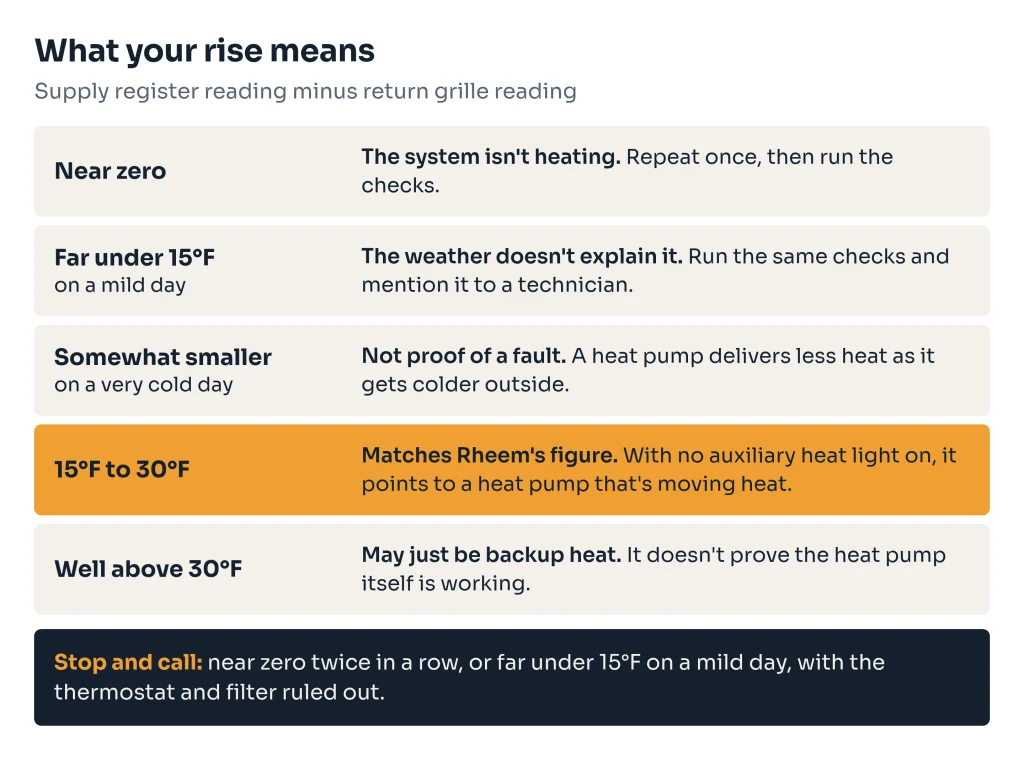
Three limits. We found no maker’s published number for a failing rise. The cut-offs on contractors’ blogs are their own rules of thumb, so don’t treat one as a spec. Rheem’s range comes from an old manual (the PDF dates from the 2000s), so your own manual comes first, and the Consortium for Energy Efficiency’s owner guide notes that inverter and multi-speed systems vary their output. And Rheem’s range is about air from grilles and registers, so it doesn’t carry over to a mini split. For a ductless head, go by whether the room reaches the set temperature.
Why it blows cold air, then warm: defrost
In heating mode the outdoor coil runs colder than the outdoor air, 10°F to 20°F colder, Trane says, so frost forms on it. To clear the frost, Rheem’s manual says, the system reverses and stops the outdoor fan, sending heat to the coil instead of the house. Carrier says cold air is often caused by this and calls it a normal function.
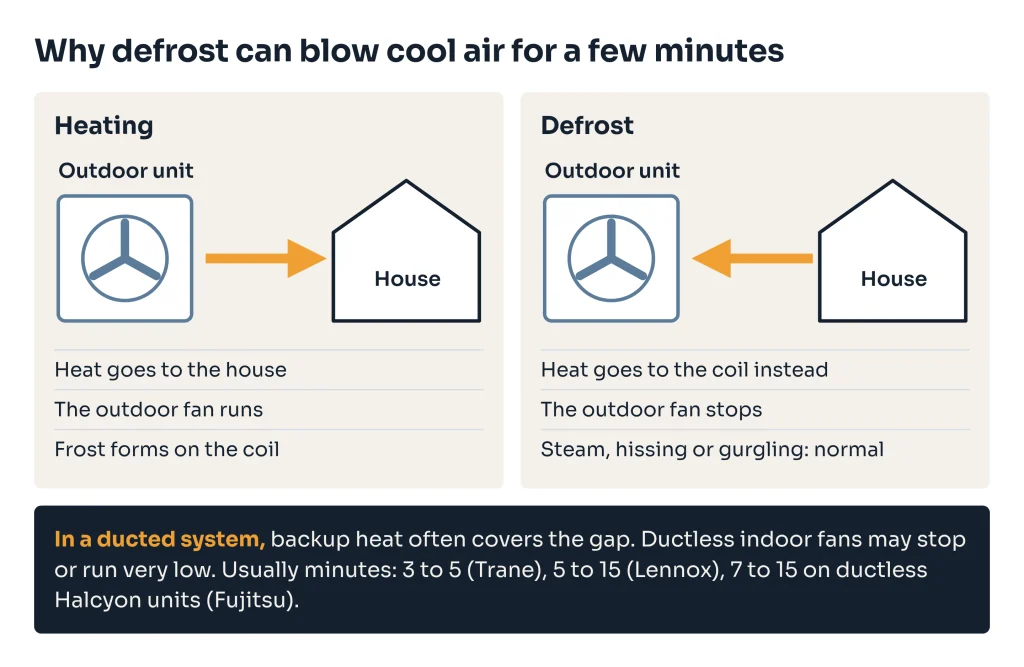
What’s normal varies by maker, so use these as a range, and your own manual for your unit:
| Question | What the makers say |
|---|---|
| How long? | Usually 3 to 5 minutes on its own systems (Trane). Usually 5 to 15 minutes (Lennox). 7 to 15 minutes on ductless Halcyon units (Fujitsu) |
| How often? | Timer units every 45 to 90 minutes, sensor units as much as 6 hours apart (Rheem). Timers at 30, 60 or 90 minutes (Lennox) |
| In what weather? | Frost may start below 45°F and is heaviest on damp days at 35°F to 40°F (Rheem). Possible in the low 40s, more common in the 20s and 30s (Trane) |
| What will you see? | The outdoor fan stops, with hissing or gurgling and a cloud of steam, all called normal (Rheem) |
Whether you feel cold air during defrost depends on what’s installed. In a ducted system, backup heat often covers the gap: Trane says backup electric strips come on and that most homeowners have them, leaving what it calls a small 1% of homes who may notice cool air, and says that’s normal too. An older York sequence of operation (revision marked 0500, apparently May 2000) shows the same design, turning on the first stage of heat during defrost. Bailes notes that not all heat pumps have auxiliary heat.
Ductless systems behave differently. The Consortium for Energy Efficiency’s guide, hosted on a Department of Energy site, says the indoor head may put off some cooling during defrost. Mitsubishi’s M Series manual says the indoor fan will stop or run at very low speed at startup and during defrost, and Fujitsu says the fan runs temporarily very low when heating starts so internal parts can warm up.
If your ducted system never used to blow cold during defrost and now does, mention it to your technician. The backup heat may not be coming on. And on a ducted system, a short burst of cold air right at startup can simply be air that has been sitting in ducts in an attic or crawl space.
Defrost has gone wrong when it won’t finish. Trane says to call a dealer if the unit seems to be constantly switching into defrost, or if cycles get longer while ice spreads. Rheem says a coil can be almost covered in frost, and not to worry unless it builds into a thicker layer with areas of hard clear ice. For that case, see heat pump freezing up in winter. Don’t chip the ice or pour hot water on it, and follow your manual.
Checks you can do yourself
These are the checks owners’ manuals allow. Apart from sliding out a filter, none involves opening anything.
- Thermostat mode. It should say Heat, not Cool, and Rheem says the set point must be above room temperature for the system to start. Auto can also work, but the Consortium for Energy Efficiency guide advises Heat in winter, because Auto can switch to cooling on a sunny winter day. Replace the batteries if your thermostat uses them and the display is blank or dim.
- Fan setting. Set it to Auto. On, the fan runs all the time, so it blows air between heating cycles with no heat added. That air can feel cold, especially from ducts in an attic, and Carrier names a constant-fan setting as a cause of cold air. The Consortium for Energy Efficiency guide says continuous fan use can harm heat pump performance.
- Filter. Rheem says to shut off the electrical power before any maintenance, so turn the system off first and follow your manual. Hold the filter up to a light. Lennox says to replace it if you can’t see through it. Rheem says to check filters at least monthly. The Consortium for Energy Efficiency guide gives about every 90 days for ducted filters and at least monthly for ductless ones.
- Registers and returns. Open all of them, and keep them clear of furniture and drapes.
- Outdoor unit: look, don’t open. Is the fan turning? Remember it stops for a short time during defrost. Rheem says to keep fences, shrubs and snow drifts at least two feet from the coil’s air inlets, and to clear drifts around the unit so defrost water can drain away. Clear snow from around the unit, not from inside it. If something is packed into the coil, leave it to a technician or follow your manual. Rheem’s says to turn the electricity off before cleaning.
- Breakers. Rheem’s list starts with checking breakers or fuses for both units, and Carrier notes that the outdoor and indoor units have separate breakers. This fits room-temperature air: the indoor fan runs, the outdoor unit doesn’t. Lennox says to flip a tripped breaker fully off, then on. If it trips again, stop. There may be an electrical fault, and that’s a job for a professional.
After a power cut or a breaker left off
Rushing a restart can put the compressor at risk. Rheem’s manual says power should be on at the outdoor unit for at least 8 hours before you turn the heat pump on, and that 12 hours is better in cold weather, to prevent compressor damage. After an outage, it says to leave the heat pump off until power has been back as long as it was off, up to 8 hours, and to use Emergency Heat if you need it meanwhile. That’s Rheem’s rule. Check your own manual, and if you can’t find it, ask your installer.
After a new thermostat
If the cold air started right after a thermostat swap, suspect the setup first. A heat pump thermostat has a reversing-valve setting, often labeled O/B. Get it wrong and, as Sensi’s support page puts it, your system is “cooling in Heat Mode, and heating in Cool Mode.” On Sensi’s smart and Touch models the default is O, and it says to switch to B only if you have exactly that symptom. Other thermostats differ, so use their own setup guide. Changing a menu setting is fine. If it needs wiring changed, that’s for the installer or a technician.
Faults that need a technician
If the checks don’t explain it and the rise is near zero, these are the usual suspects. Each one is a diagnosis for a technician, not a repair for you.
- Outdoor unit not running. The indoor fan moves air, but no heat is being collected. If the outdoor fan is the part that’s stopped, see heat pump fan not spinning. Capacitors, contactors, control and defrost boards, disconnects and wiring all go to a technician or licensed electrician.
- Stuck reversing valve. Carrier’s clue: the system heats poorly but cools normally. Lennox says a stuck valve can produce cold air even in heat mode and needs professional repair.
- Low refrigerant. This means a leak, and it needs a technician. Under Section 608 of the Clean Air Act, EPA requires certification for technicians who service equipment that could release refrigerant. Never add or top off refrigerant yourself. A top-up with no leak found isn’t a repair, so ask where the leak is.
- Leaky or uninsulated ducts. In his Green Building Advisor article, Bailes names return-side duct leaks and poorly insulated ducts in unconditioned space as causes of cold air that apply to heat pumps and furnaces alike. If one room is cold but the register nearest the indoor unit is fine, look here.
One case isn’t a fault. Rheem describes a balance point, the outdoor temperature where the heat your house needs equals what the heat pump can deliver. Below it, the heat pump runs continuously and auxiliary heat cycles on and off as needed. Long runs of mild air in a cold snap can be exactly that. What temperature heat pumps stop working at goes through the limits. But the Consortium for Energy Efficiency guide lists a set temperature that’s never reached as a sign the system isn’t working properly, so call if the house can’t hold it. The backup may have failed, or the system may not match the house.
When to stop and call
Stop checking and call a technician if any of these is true. The list comes from the Rheem, Lennox, Trane and Consortium for Energy Efficiency guidance above.
- A rise near zero twice in a row, or far under 15°F on a mild day, with the thermostat and filter ruled out.
- The house keeps losing temperature or never reaches the set point.
- Thick or clear ice stays on the outdoor unit after a defrost, or defrost seems constant.
- A breaker trips again after one reset.
- The unit turns on and off rapidly and isn’t heating properly.
- The thermostat shows auxiliary heat often outside a cold snap, or an Emergency Heat light you didn’t turn on. Rheem says a monitor control, where fitted, can switch to auxiliary heat and light it to show the system needs attention.
- New, unusual noises, or an error code.
For a burning smell or smoke, which Lennox lists as a reason to call, turn the system off at the thermostat and call. If you see fire or smoke is spreading, get out and call 911.
Emergency heat while you wait
This is what emergency heat is for. Carrier says that if the outdoor unit isn’t working, you can switch to it to use the supplemental source, and Rheem describes it as shutting off the compressor and outdoor fan and heating from electric strips only. Your system’s backup may be different, so check what yours uses.
It’s a bridge to a repair, not a fix. Electric strips turn one kWh into 3,412 Btu of heat, while that Rheem unit is rated at a COP of 2.5 at 17°F, so strips would use about 2.5 times the electricity for the same heat (our arithmetic, on a rating rather than a home result). Carrier warns it can significantly increase your bill. To put your own numbers on it, use the emergency heat cost calculator.
What to tell the technician
A clear account can shorten the visit. Have these ready:
- Your two thermometer readings, the outdoor temperature and the time.
- Whether the outdoor fan and compressor run, and whether you saw steam or ice.
- How long the cold air lasts, and how often.
- Whether the thermostat, or anything else, was changed recently.
- Any code or light on the thermostat, and the model number on the outdoor unit.
Then ask for the diagnosis in writing: what failed, what was measured, and what was replaced. For refrigerant work, that means where the leak was, how it was fixed, and how much refrigerant went in. If the repair is large or the unit is old, repair, replace or go back to gas walks through the choice, and going back to a furnace is a normal answer. The Last Furnace sells and installs nothing, so the decision stays with you and a technician you trust.
General information, not professional, tax or legal advice. Follow the manual for your own equipment, which overrides anything here.
Sources checked on 4 November 2026.
Sources
- Rheem: Owner's Information Manual for Heat Pumps, 92-20802-03-09 (older dealer-hosted copy, PDF dated 2002 to 2006)
- Rheem: WP14AY series product sheet, P33-846 Rev. 2 (February 2025), WP14AY36AJ2N with WH2TY3617STANN
- Trane: What Is a Heat Pump Defrost Cycle? (19 February 2026)
- Carrier: Heat Pump Not Heating? Here's How to Troubleshoot (15 September 2026)
- Lennox: Heat pump blowing cold air (17 February 2026)
- Fujitsu Halcyon troubleshooting FAQ (Airstage site)
- Mitsubishi Electric M Series manual, MSZ-SF indoor unit, cold air prevention control, page C-227
- York: 10, 12 and 14 SEER heat pump installation instruction, 035-15713-003 Rev. A, sequence of operation, dated 0500
- Consortium for Energy Efficiency, on the US Department of Energy's Building Science Education site: You Installed an Air Source Heat Pump. Now What? (January 2024)
- Minnesota Division of Energy Resources: Air Source Heat Pump Efficiency Gains from Low Ambient Temperature Operation (June 2011)
- Allison Bailes, Energy Vanguard: Is heat pump supply air too cold for heating? (13 February 2024)
- Allison Bailes, Green Building Advisor: 'Cold Blow' from Heat Pump Supply Air (9 May 2024)
- Sensi support: My heat pump cools in Heat mode or heats in Cool mode
- EPA: Section 608 Technician Certification Requirements
- EIA: British thermal units