When a heat pump isn’t heating, check the thermostat first, then the filter, the outdoor unit and the breaker panel, in that order. If none of those solves it, what the system is doing tells you what comes next: a normal pause, a cold snap the unit was never going to cover alone, or a fault that needs a certified technician.
This page covers the whole problem: no heat at all, a system that won’t turn on, and one that runs all day while the house falls behind. It stops where the owner’s part stops. For other symptoms, start with the heat pump symptom chart. The Last Furnace sells and installs nothing, so nothing here leads to a quote.
What is your system doing?
Stand by the thermostat, then go outside and look at the outdoor unit. Match what you find to a row. The right-hand column is the next step, not a diagnosis.
| What you see | Likely reason | Next step |
|---|---|---|
| Thermostat screen blank | Dead batteries or no power to the thermostat | Replace batteries if it has them, then check the breakers |
| Screen on, nothing runs indoors or out | Wrong mode, a built-in delay, or a tripped breaker | Set Heat, set the temperature above room temperature, wait 5 minutes, then check the breakers |
| Cool air for a few minutes, outdoor fan stopped, steam rising | Defrost, which is normal | Wait it out. See below |
| Outdoor unit runs, air stays cool for more than 15 minutes | Fan set to On, a thermostat setting, a stuck reversing valve or a refrigerant leak | Run the checks below, then call. See heat pump blowing cold air |
| Air is warm, but the house can’t reach the setting on the coldest days | Dirty filter, the unit’s capacity falling in the cold, or backup heat not working | Check the filter, then read the cold-weather section |
| Thick ice on the outdoor unit that stays after defrost | Airflow or a defrost fault | Clear drifts around it, don’t chip it, then see heat pump freezing up |
| Outdoor fan stays still past a defrost, unit hums or clicks | An electrical part may have failed | Turn it off at the thermostat and call. See fan not spinning |
| Breaker trips again, or a burning smell | Electrical fault | Leave it off and call |
Three things that look broken but aren’t
Defrost
In cold weather the outdoor coil collects frost, and the unit clears it by running its cycle in reverse. Rheem’s owner section describes the outdoor fan stopping, the compressor still running, and steam rising from the unit. Trane says the system blows cool air while it’s in defrost and goes back to heating afterward.
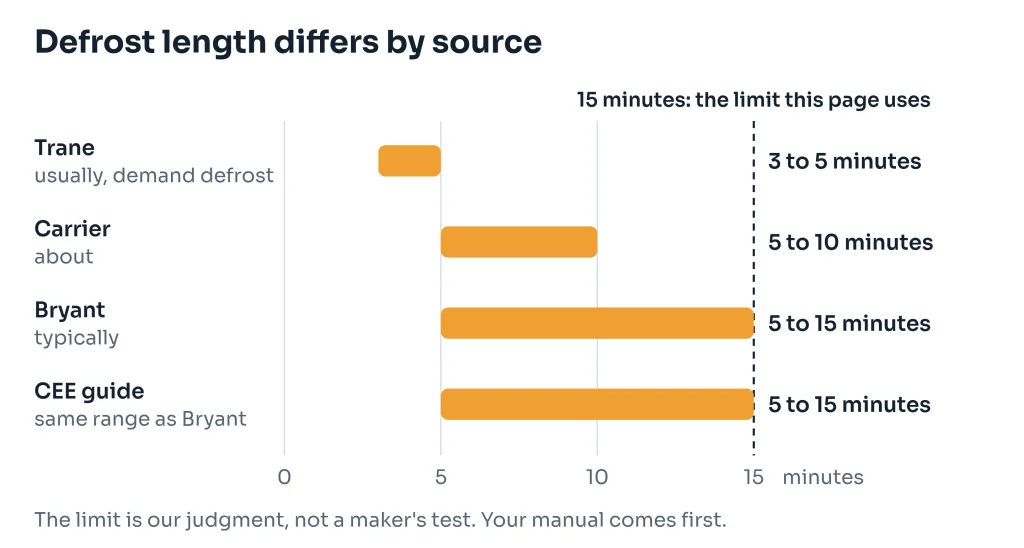
Makers don’t agree on how long this takes. Trane says usually 3 to 5 minutes for its demand-defrost systems, Carrier about 5 to 10, and Bryant typically 5 to 15, the same range as a CEE guide for new owners on a DOE training site. So 15 minutes is the longest figure in these sources, and it’s the limit this page uses, which is our judgment and not a maker’s test. If the system seems stuck in defrost, the CEE guide says to consult a professional, and American Standard says to call a dealer if the unit keeps going into defrost, or cycles keep getting longer, and ice and frost start covering it.
Air that feels lukewarm
Carrier gives about 85 to 100°F at the vent for a heat pump, against roughly 120 to 140°F from a gas furnace. Air at that temperature can feel cool on your hand even when the system is working. The CEE guide describes a gentle, steady airflow that runs for longer. So judge it by the room thermometer over an hour or two, not by your hand at the register. Carrier’s figure is a maker’s general range, not a pass or fail test.
A delay after any change
Most systems won’t restart the moment you ask. Rheem’s manual says a protective timer holds the outdoor unit off for about five minutes after it last ran or after a power interruption. A 2013 split-system user’s manual gives about three minutes. Lennox’s S40 thermostat guide lists a five-minute safety delay. After changing a setting, wait five minutes before deciding nothing happened.
A long power cut can mean a much longer wait. A 1997 Lennox HP29 owner’s manual says that if power was off for several hours or more, set the thermostat to Emergency Heat for temporary heat, because the compressor needs a six-hour crankcase heater warm-up before you go back to Heat. That’s one older model. Others may differ, so check yours.
What you can safely check
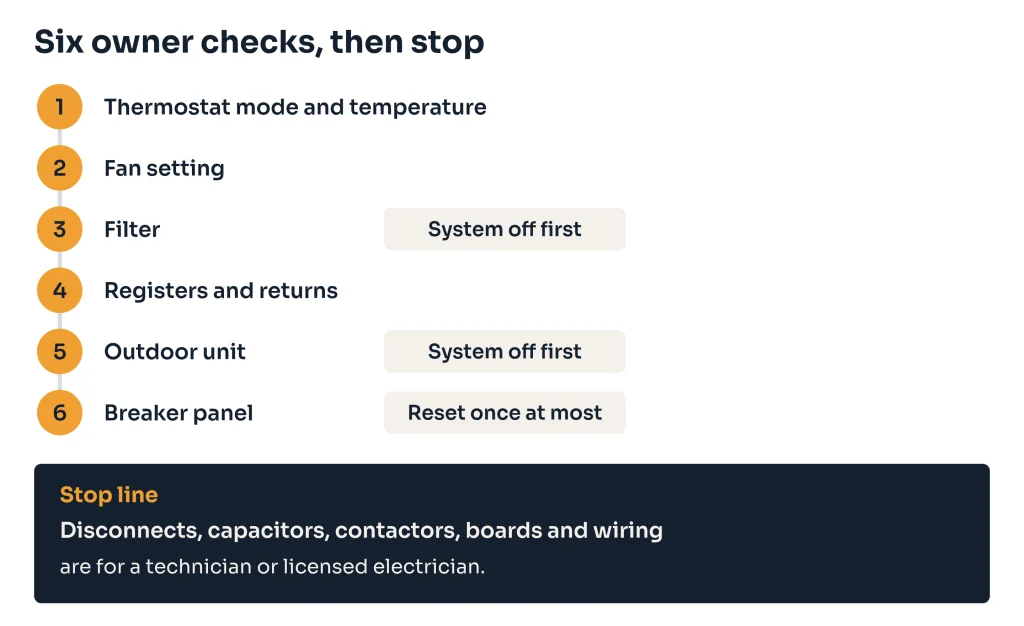
Owner’s manuals agree on a short list. Rheem’s asks you to confirm the thermostat setting and the power, and the 2013 manual adds filters and a clean outdoor unit. Do these in order. Rheem’s also says to disconnect power to the outdoor unit and air handler before its filter and coil maintenance, and the 2013 manual says to disconnect all electrical power before any maintenance. So for steps 3 and 5, turn the system off at the thermostat, and switch off its breakers too if your manual says to or you don’t have it to hand. Keep your hands out of the unit, and turn everything back on when you’re done.
- Thermostat mode and temperature. Set the mode to Heat and the temperature a few degrees above the room. Efficiency Maine advises against Auto in winter, because Auto alternates between Cool and Heat. If the screen is blank, Trane says it has no power: replace the batteries if it uses them.
- Fan setting. Set the fan to Auto. With the fan set to On, Trane notes, the system blows air even when it isn’t heating, and that air feels cold.
- Filter. Pull it and look. ENERGY STAR says to inspect it every month, and notes that airflow problems can cut efficiency by up to 15 percent. Replace it or wash it if yours is washable. Never run the system without one: the 2013 manual warns that dust on internal parts can damage the equipment and create a fire risk.
- Registers and returns. Make sure furniture and rugs aren’t covering them. Open doors to rooms with no vents, as the CEE guide suggests.
- Outdoor unit. Clear leaves, and clear snow drifts from around it. Efficiency Maine says not to worry about ordinary snow and ice on the unit, because heat pumps defrost themselves, and to take care not to bend the fins. Pilot notes from MassCEC, a Massachusetts clean energy agency, warned in 2019 that even a unit raised a foot or two can need shoveling after a big storm. Carrier asks for at least 24 inches of clear space; your manual’s figure comes first.
- Breaker panel. Look for a tripped breaker. The 2013 manual says a unit can have more than one electrical supply, so check every breaker marked for the heat pump, air handler or heat strips. There’s also often a switch at the indoor unit that looks like a light switch: Carrier says to confirm it’s on.
About resetting the breaker. Advice conflicts. Bryant says reset it once and, if it trips again, leave it off and call. Trane says resetting and restarting could cause further damage, and recommends a service call. A breaker trips for a reason, so follow your own manual. If you do reset it, do it once. If it trips again, or anything smells hot, leave it off.
Stop there. Some guides also send you to the disconnect box beside the outdoor unit. Disconnects, capacitors, contactors, boards and wiring are for a technician or licensed electrician. If the box looks switched off or damaged, say so when you call. One practical reason to do these checks first: the 2013 manual lists resetting breakers and adjusting a thermostat among service calls its warranty doesn’t cover.
Thermostat settings that look like faults
A new thermostat. If the trouble started right after a thermostat swap, suspect the setting that tells the reversing valve which way to run. Google’s Nest help page covers exactly this: cool air in heat mode, fixed by switching the heat pump setting between O and B in the app or on the device. It’s a setting, not a wiring job. For any other brand, ask whoever installed it.
A big overnight setback. Turning the heat down a long way, then up in the morning, can make a heat pump look like it can’t catch up. Efficiency Maine says turning it down may use more energy than leaving it alone. The CEE guide says to avoid abrupt changes of 3°F or more during unoccupied hours, and to move the setting a few degrees at a time for nighttime comfort. It also says setbacks typically save energy if you’re away for more than a day. Hold one setting for a day before judging the system.
A lockout setting. Some controls stop the heat pump below a set outdoor temperature on purpose. Lennox’s S40 guide says that below the “low balance point”, typically 25°F by default and adjustable by the dealer, only auxiliary heat runs, and an ambient lockout notice appears on the home screen. If your outdoor unit shuts down on cold days while the backup carries the house, it may be following a setting rather than failing. In a 2020 British Columbia field study, most central systems cut back or stopped heating and leaned on backup once it got cold: 3°C to -5°C (about 37°F to 23°F) in the summary, -5°C to -8°C (about 23°F to 18°F) in the body of the report. The report doesn’t say why. It only lists the systems’ cut-off temperatures for backup heating as a question for future study, so it proves nothing about your unit, but it’s worth asking about. A Bonneville Power Administration reference for its PTCS program says incorrect lockout settings cause most of that program’s inspection failures, and that compressor lockouts, though not required by the program’s spec, should be off so the compressor can run at all outdoor temperatures. That’s one regional program’s advice, not a universal rule. Ask your installer what yours is set to and why, and leave installer menus alone.
When the cold is the reason
A heat pump can be working correctly and still fall behind. As it gets colder, the house loses heat faster and the unit delivers less. Past the point where those lines cross, backup heat has to fill the gap. Maker sheets let you put numbers on this.
Take one ordinary 3-ton unit, the Rheem WP14AY36AJ2N with the WH2TY3617STANN air handler, named only as an example. Its sheet lists 33,600 Btu/h at 47°F and 22,200 at 17°F. That’s 66% of the 47°F figure (our arithmetic). Now imagine a house that needs 30,000 Btu/h at 17°F. That number is made up for this example. Assuming its heat need falls in a straight line to zero at 65°F, also our assumption:
| Outdoor temperature | House needs (example) | Unit delivers | Gap |
|---|---|---|---|
| 47°F | 11,250 Btu/h | 33,600 Btu/h (sheet) | None |
| 30°F | 21,875 Btu/h | 27,140 Btu/h (straight line between sheet points) | None |
| About 25°F | About 25,000 Btu/h | About 25,000 Btu/h | Lines cross |
| 17°F | 30,000 Btu/h | 22,200 Btu/h (sheet) | 7,800 Btu/h, about 2.3 kW of backup |
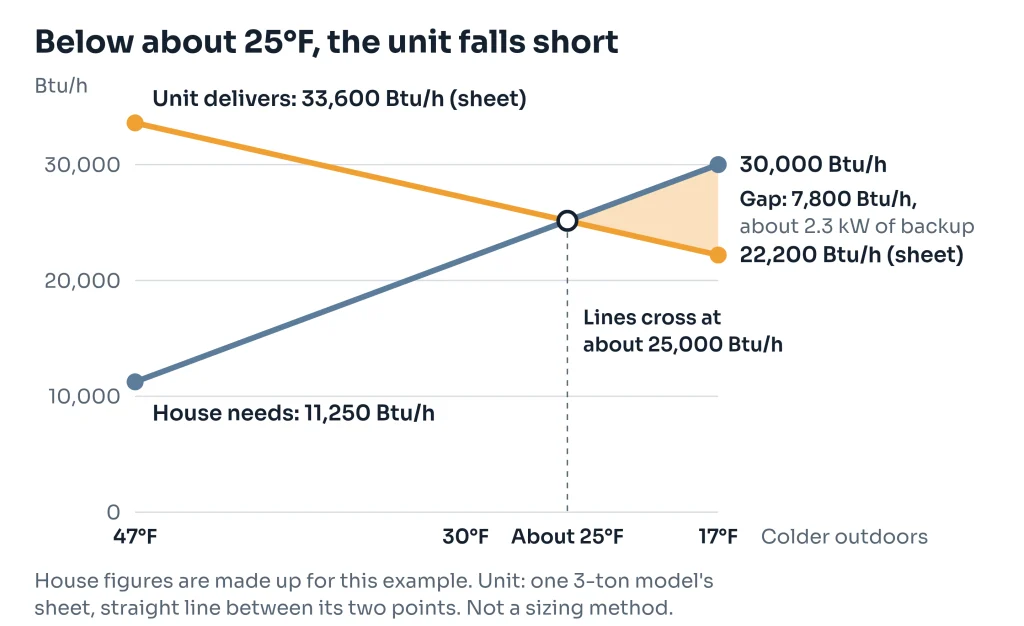
That house stays warm only because backup heat covers the gap below about 25°F. If the strips are off at a breaker, or have failed, the same heat pump runs nonstop and the room temperature slides. It’s easy to blame the heat pump when the missing part is the backup. So a technician should test both.
Units certified as cold climate meet a stricter test. ENERGY STAR’s cold-climate criteria require at least 70% of the 47°F capacity at 5°F. The Rheem sheet shows no 5°F figure at all. For what different units do at each temperature, see what temperature heat pumps stop working. Carrier says older heat pumps may struggle below 25 to 30°F and need supplemental heat.
A falling-behind check. A cold-snap shortfall usually tracks the weather: it starts as the temperature drops and ends as it rises. If the house fell behind on a mild day when it used to cope, or the same weather last winter was fine, treat it as a fault. The CEE guide says a sudden jump in your kWh is the most common sign of trouble. It also lists these as reasons to contact a professional: a setpoint that’s never reached, and auxiliary mode showing constantly.
If you need heat tonight
Emergency Heat is the thermostat setting for this. It locks out the outdoor unit and runs the backup alone. Rheem says it’s for use only if a problem with the outdoor unit is suspected, and warns that sustained use raises your electric bill. Carrier’s page names electric strips or a gas furnace as the auxiliary source, so in a home with a furnace, it may be the furnace that runs.
Electric strips cost real money. Read the kW on the nameplate: at EIA’s August 2026 US residential average of 18.16 cents per kWh, each kW costs about 18 cents an hour, so a 10 kW strip (an example size, not a typical one) costs about $1.82 an hour at full output (our arithmetic). That’s a summer rate, and your own bill is the better figure. COP is units of heat per unit of electricity, and strips sit at 1. The Rheem sheet rates that unit at COP 2.5 at 17°F, so on that rating the strips use 2.5 times as much electricity for the same heat. A rating isn’t what a home will get. The emergency heat calculator runs this for your own unit.
Use it to stay warm until the repair, not as a substitute for one. If there’s no heat at all, a few rules from federal safety agencies matter more than anything else on this page:
- Never heat the home with a gas range or oven, and never run a generator indoors, says the CDC.
- Space heaters: keep them at least 3 feet from drapes, furniture and bedding, and never on furniture or near water, says the CDC.
- Pipes: the same CDC page says to leave taps slightly open so they drip, and never to thaw a frozen pipe with a torch.
- Babies and older adults: the CDC says infants should never sleep in a cold room, and that people over 65 should check the home’s temperature often. If it’s too cold, its power outage page says to seek shelter with friends or at a community shelter.
- Carbon monoxide: if you suspect it, CPSC says to get outside to fresh air first, then call 911.
When to stop and call
Call a qualified technician, and don’t keep restarting the system, if any of these is true:
- A breaker trips a second time.
- You smell burning, or hear grinding or other excessive noise. Bryant names grinding and the CEE guide excessive noise.
- The unit clicks but won’t start. Trane says a failed capacitor can do this.
- You hear hissing near the outdoor unit. Trane says that could be a refrigerant leak and to call right away.
- Ice covers the coil and stays after defrost. Carrier’s line is ice thicker than 1/4 inch or ice that remains after defrost.
- The outdoor unit runs but the air is still cool after 15 minutes and the checks above changed nothing.
- The indoor temperature stays consistently more than 2 to 3°F from the setting, which is Carrier’s trigger for having it checked, and the weather doesn’t explain it.
- Any part has been under water. The 2013 manual says not to use the appliance and to call a technician at once.
Refrigerant. Low refrigerant means a leak, which Trane calls the only cause, and there’s no owner fix. Don’t add, top off or vent it, and don’t open a line. EPA requires Section 608 certification for technicians who maintain, service or repair equipment that could release refrigerants.
Ice. Don’t chip it, and don’t pour hot water on it. Bryant warns that chipping with a hard tool can damage the coil. If your manual says to shut the unit off, do that, then call.
What to tell the technician
A clear account saves time. Before you call, write down the model number from the outdoor unit, which the Lennox HP29 manual also tells you to have ready, and the install date. Then note:
- What the thermostat, indoor fan and outdoor unit each do, and any code on the screen.
- The outdoor temperature when it failed, and whether it was fine at that temperature before.
- What you already checked, including any breaker you reset.
- Anything recent: a new thermostat, a power cut, a storm, work on the panel.
Then ask for specifics. The usual suspects behind a no-heat call are a leak, a stuck reversing valve, a failed electrical part or board, and failed backup heat. An installer interviewed for the MassCEC pilot notes named refrigerant leaks and circuit board failures as issues he’d seen recur on service calls. It’s one installer’s account, not a national rate. These five questions apply to any of them:
- What failed, and how did you confirm it?
- If refrigerant is low, where is the leak, and will you fix it or only refill it?
- Did you test the backup heat, and does it come on when it should?
- Is a lockout set, and at what outdoor temperature?
- Is any of this under warranty?
If the repair is large and the unit is old, that’s a separate decision. A 2011 Lawrence Berkeley lab estimate put the median heat pump lifespan at 14.6 years. That comes from survey data on older equipment, and it says nothing certain about yours. Going back to gas is a normal choice too: see repair, replace or go back to gas.
If it’s a ductless mini split
Most of this applies, with four differences:
- Mode: check the remote as well as any wall control. Trane’s first question is whether the unit is really in heat mode. Use Heat, not Auto.
- Filters: check the one in each indoor head. The CEE guide says to clean them monthly at a minimum, following the maker’s directions, and Efficiency Maine says your manual explains how to remove them.
- Defrost: the CEE guide says the indoor head may put off some cooling during defrost.
- Room feel: the temperature is read at the unit, high on the wall, so it may need a higher setting to feel right, Efficiency Maine says.
Trane suggests turning the unit off for several minutes, then back on. If lights are blinking, look the pattern up in your manual, since codes differ by maker, and pass it on to the technician.
Sources and notes
Owner’s manuals differ by model and age, and several cited here are older documents for older units. Yours overrides anything on this page. Maker pages are the makers’ own statements. The table of house heat needs is an illustration with made-up numbers, not a sizing method: a qualified installer decides what your home needs. This is general information, not professional, tax or legal advice. The Last Furnace sells nothing and takes no fees from installers or makers.
Sources checked on 4 November 2026.
Sources
- Carrier: Heat pump not heating (updated 15 September 2026, maker's page)
- Trane: Common reasons for your heat pump not heating (undated, maker's page)
- Trane: Heat pump not turning on (undated, maker's page)
- Trane: Mini-split not working in heat mode (undated, maker's page)
- Trane: What is a heat pump defrost cycle (maker's blog)
- American Standard: What is a heat pump defrost cycle (16 February 2026, maker's blog)
- Bryant: Heat pump not heating (undated, maker's page)
- Rheem: Outdoor Heat Pump, User's Information/Installation Instructions, 13 SEER split system (older manual)
- User's Manual, Split System Heat Pump, part 709573 (05/13)
- Lennox: HP29 owner's manual (1997)
- Lennox: S40 smart thermostat user guide, 508223-03 (4/2026)
- Rheem: WP14AY series product sheet
- ENERGY STAR: Heat pump specification Version 6.2, Rev. March 2025
- ENERGY STAR: Maintenance checklist
- CEE: You installed an air source heat pump, now what? (hosted on DOE's Building Science Education Solution Center)
- Efficiency Maine: Heat pump user tips
- MassCEC: Lessons from the field, month seven of the whole-home ASHP pilot (20 December 2019)
- Bonneville Power Administration: PTCS lockouts and balance points reference guide
- RDH Building Science: BC Cold Climate Heat Pump Study, Final Report (November 2020)
- Google: Troubleshoot when heating and cooling are reversed (Nest help)
- EPA: Section 608 technician certification requirements (updated 15 July 2026)
- EIA: Electric Power Monthly Table 5.6.a, August 2026 (released 23 October 2026, preliminary)
- LBNL: Lutz et al., residential equipment lifetimes (October 2011)
- CDC: What to do to protect yourself during a power outage (reviewed 26 August 2026)
- CDC: Safety guidelines during and after a winter storm (25 August 2026)
- CPSC: Carbon Monoxide Information Center