Most heat pump troubleshooting comes down to one question: is this a normal behavior that looks like a fault, or a fault that needs a technician? Find what your system is doing in the chart below. Each row gives the likely reason and your next step, and the longer guides go through the checks, the stop lines and what to tell the technician.
If the system is failing today, use the chart, then the owner checks, then the stop line. If you only want to know whether something is normal, go to what looks broken but isn’t. If nothing is wrong yet, start with getting ready for next winter.
The Last Furnace sells and installs nothing, so nothing here leads to a quote. Your own manual overrides this page. This page is general information, not professional, tax or legal advice.
Heat pump symptom chart
Look at the thermostat, then go outside and look at the outdoor unit. The last column is your next step, not a diagnosis.
| What you notice | Usually means | Next step |
|---|---|---|
| Cool air or a whoosh for a few minutes, outdoor fan stopped, steam rising | Defrost, which is normal | Wait. It should end within 15 minutes |
| Lukewarm air all the time, and the house holds its temperature | Normal heat pump air | Nothing to fix. The thermometer test in heat pump blowing cold air settles it |
| Air at room temperature or colder well past a defrost, and the house is losing temperature | Fan set to On, a thermostat setting, the outdoor unit off, a stuck reversing valve or a refrigerant leak | Run the checks below, then call |
| Blank thermostat, or nothing runs indoors or out | Dead batteries, the wrong mode, a built-in delay or a tripped breaker | Run the checks below. The full path is in heat pump not heating |
| Air is warm, but the house can’t reach the setting on the coldest days | A dirty filter, capacity falling in the cold, or backup heat not working | Check the filter, then see the cold-snap note below |
| White frost on the coil that clears on the next defrost, even if it nearly covers it | Normal frost | Nothing. Check that it clears |
| Hard, clear ice that keeps thickening, or defrost running back to back | Not normal: a defrost, airflow or other fault | Clear drifts around the unit, don’t chip it, then see heat pump freezing up |
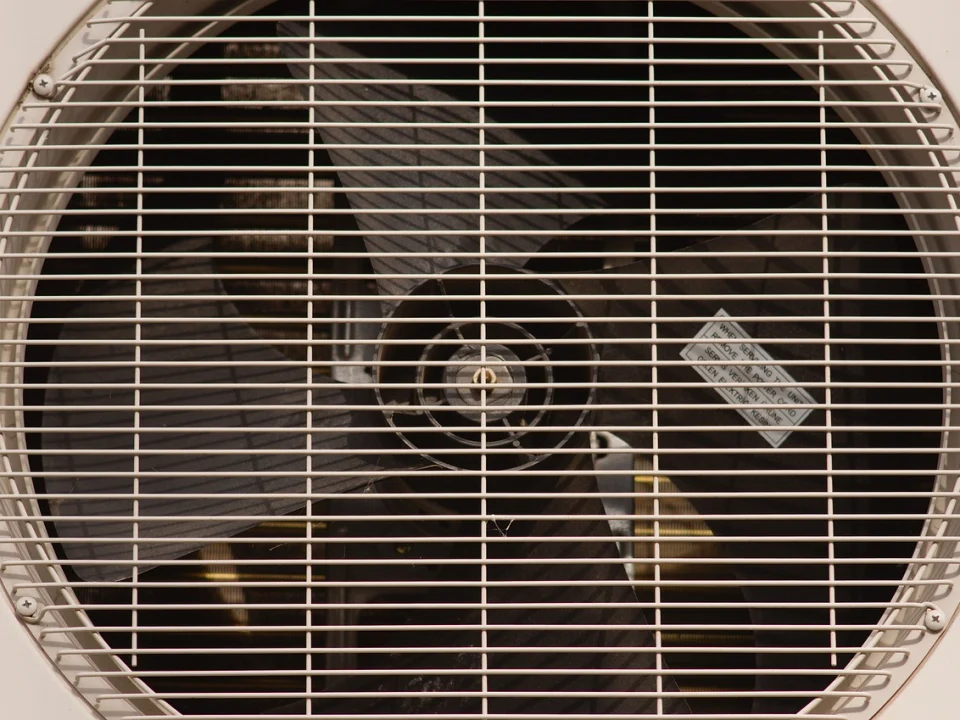
| Outdoor fan still for more than 15 minutes while the unit hums or runs | A failed capacitor, motor or control | Turn it off at the thermostat and call. See heat pump fan not spinning |
| New grinding, banging, squealing or a loud buzz, or a noise that won’t stop | A failing part or something touching the fan | Turn it off and call. Heat pump noise sorts sounds by what they usually mean |
| A steady hiss outside defrost, or near the refrigerant lines | Possibly a refrigerant leak | Turn it off and call |
| Aux heat on for a few minutes, or as it gets colder | Usually normal | Nothing. See backup heat below |
| Aux heat on for hours in mild weather, or an Emergency Heat light you didn’t turn on | The system may need attention | Call a technician |
| A breaker trips again, or a burning smell | An electrical fault | Leave it off and call |
The owner checks, in order
Owner’s manuals agree on a short list, and that list is most of what an owner can do to fix a heat pump. Turn the system off at the thermostat before touching the filter or clearing the outdoor unit, and switch off its breakers too if your manual says to.
- Thermostat. Set it to Heat, with the temperature above the room’s. If the screen is blank, replace the batteries if it uses them. Then wait 5 minutes.
- Fan setting. Set it to Auto. On, the fan blows air between heating cycles, and that air feels cold.
- Filter. ENERGY STAR says to inspect it every month. Replace it if it’s dirty, and never run the system without one.
- Registers and returns. Open them and move furniture off them.
- Outdoor unit. Look from outside the cabinet. Clear leaves and clear snow drifts from around it.
- Breakers. Check every breaker marked for the heat pump, air handler or heat strips. Advice on resetting one conflicts: Bryant says reset it once, and Trane says that can cause further damage and recommends a service call. Follow your manual, and never reset one more than once.
What looks broken but isn’t
Defrost. In cold weather the outdoor coil collects frost, so the system reverses to melt it, and the outdoor fan stops. An older Rheem owner’s manual says frost can start below 45°F and is heaviest on damp days at 35°F to 40°F, so a raw, foggy day can bring more of this than a dry, bitter one. Times vary by maker: usually 3 to 5 minutes on Trane’s own systems, typically 5 to 15 on Bryant’s web page, and 7 to 15 on Fujitsu’s ductless Halcyon units. Fifteen minutes is the longest of those figures, so it’s the limit this chart uses. That’s our judgment, not a maker’s test.
Lukewarm air. Carrier gives about 85°F to 100°F at the vent for a heat pump, against roughly 120°F to 140°F from a gas furnace. That’s a maker’s general range, not a pass or fail test. Air like that can feel cool on your hand while the system works, so judge it by the room thermometer over an hour or two.
A delay. Most systems won’t restart the moment you ask. A Rheem manual describes a protective timer that holds the outdoor unit off for about five minutes, so give any change five minutes before deciding nothing happened.
A cold snap. As it gets colder, the house loses heat faster and the unit delivers less, so backup heat has to fill the gap. That shortfall usually tracks the weather. If the house fell behind on a mild day, or the same weather last winter was fine, treat it as a fault. What temperature heat pumps stop working at goes through the limits.
The stop line
Your part ends at the breaker panel and the outside of the cabinet. Panels, disconnects, capacitors, contactors, control and defrost boards and wiring are for a technician or licensed electrician. Hold to these:
- Refrigerant. Low refrigerant means a leak, and there’s no owner fix. Don’t add, top off or vent it, and don’t open a line. EPA requires Section 608 certification for technicians who service equipment that could release refrigerant.
- A stopped fan. If the unit sounds like it’s running but the outdoor fan isn’t spinning, turn it off at the thermostat. Trane warns that the compressor can overheat and fail without the fan. Don’t leave it running overnight to see what happens, and don’t push the blades to start it.
- Ice. Don’t chip it, and don’t pour hot water on it. Rheem says to call for hard, clear ice that keeps building. Trane says to wait a few hours and see whether the ice goes, and Lennox says to call if it hasn’t melted in 6 to 8 hours. Those are two makers’ rough guides, not a standard.
- Hissing. Makers disagree. Rheem calls hissing during defrost normal, and Trane says hissing isn’t a normal sound. Our reading is to go by timing: brief during defrost and then gone is one thing, and steady or near the lines is a possible leak. If you have a gas furnace on a dual fuel system and you hear a hiss with a rotten-egg or skunk smell, Trane’s advice is to leave the house and call the gas company from outside.
- Burning or smoke. Turn the system off at the thermostat and call. If you see fire or smoke is spreading, get out and call 911.
Backup heat while you wait
Leave the thermostat on Heat in cold weather. In that setting the system already brings in backup heat when it’s needed, and the heat pump keeps helping. An Aux light is usually normal: Trane lists outdoor temperatures below 40°F, defrost and a raised setpoint as ordinary causes, and says aux on for more than an hour or two above 40°F is worth investigating.
Emergency Heat is different. It’s a manual setting that locks out the compressor so only backup heat runs, and it’s for when the heat pump can’t or shouldn’t run. Use it to stay warm until the repair, not in place of one. On one example, a 9.6 kW electric backup costs about $1.74 a running hour at EIA’s August 2026 US residential average of 18.16 cents per kWh, about 2.5 times a working heat pump at a COP of 2.5, which is our assumption and not a promise. That’s our arithmetic with a summer rate, so use your own bill. If your backup is a furnace, the numbers change. The emergency heat calculator prices your own backup, and its page covers power cuts, where manuals disagree.
Switch back to Heat as soon as the repair is finished. If you have no working heat at all, the CDC says never to heat the home with a gas range or oven, and never to run a generator indoors.
If yours is a mini split
Most of this applies, with some differences. Check the mode on the remote as well as any wall control, and check the filter in each indoor head. During defrost the head may put off some cooling, or its fan may stop or slow right down. Ductless systems typically aren’t equipped with backup heat, so a failed one needs another heat source as well as a repair. For the common ductless problems, see a mini split that won’t cool, water leaking from a mini split and how to clean a mini split.
What to tell the technician
A clear account saves time. Write down the model number from the outdoor unit, the outdoor temperature when it failed, what the thermostat, indoor fan and outdoor unit each do, any code on the screen, and what you’ve already checked, including any breaker you reset. A photo of the ice or a phone recording of the noise helps, because noises have a habit of stopping when someone arrives.
Then ask what failed and how it was confirmed, and ask for that in writing. If refrigerant is low, ask where the leak is and whether it will be fixed or only refilled. Ask whether the backup heat was tested too. If the repair is large and the unit is old, that’s a separate decision. Repair, replace or go back to gas walks through it, and going back to a furnace is a normal answer.
Getting ready for next winter
Several of these problems are easier to catch before they strand you. Your monthly part is the filter and a clear outdoor unit. Rheem asks for at least two feet between the coil’s air inlets and any fences, shrubs or snow drifts, and other makers give different figures, so use your manual’s. Don’t cover the unit, because it runs all winter. Watch how often the Aux light comes on, since a backup fault can sit unnoticed until the bill arrives.
Most makers’ documents say to have a technician look at it at least once a year. Early fall is our suggestion if you book one visit, so backup heat and defrost get tested before the coldest weather. Heat pump maintenance separates your jobs from the technician’s and lists the numbers to ask for on the invoice.
Figures come from the guides linked above, where each is cited in full, and the sources linked at each claim. Sources checked on 4 November 2026.